— HOMESTEADING
The productive homestead: real outputs from balcony to small farm

— ON THIS PAGE
A productive homestead is a tradeoff, not a lifestyle. It produces food, it costs money to set up, it costs time to maintain, and the answer to “is this worth doing?” is genuinely different at different scales. Most writing on the topic gets this wrong in one of two predictable ways. The first school says “five acres minimum, anything less is a hobby garden” — wrong, too pessimistic, and discouraging to the very households who would benefit most. The second school says “you can homestead on any balcony, any windowsill, any stoep” — wrong in the other direction, too optimistic, and disrespectful of the real labour the suburban and rural versions actually demand. The honest answer is that this is scale-dependent.
This piece works the spectrum from a balcony to a small farm and answers, for each tier, the same question: what is the smallest productive setup that earns its keep? We define productive honestly, give the real outputs in rand and kilograms, the real time cost in hours per week, and the real failure modes — and then apply the Three Scales of Self-Reliance to get a defensible answer at each scale.
It is not the romance the lifestyle press sells, and it is not the sacrifice the prepping niche implies. A productive homestead is a household-scale food production operation, with measurable inputs and measurable outputs, that pays back over time at certain scales and earns its keep on different terms at others. Numbers, not feelings, get us to the right answer.
What “productive” actually means
Before applying the word productive to a homestead, we need to define it, because most homesteading content fails this definition silently and the reader is left to guess.
We mean three things by productive:
- Measurable food output. Kilograms a week, kilograms a month, rand-equivalents at the till. A garden that produces “some salad and a few tomatoes” is not measurable. A garden whose yield you can name in a sentence is.
- At a cost-per-kilogram below or comparable to the supermarket equivalent, factoring in time. The household’s hourly labour rate matters here. If you genuinely value your weekend hour at R300, then a kilogram of garden tomatoes that took 30 minutes of weekly attention to grow has to be costed at R150-of-labour plus the inputs, and that is sometimes more than the supermarket tomato. Sometimes less. The honest accounting goes both ways.
- Durably — sustained over years, not abandoned in year two. The most common failure mode in homesteading is the over-ambitious year one followed by the abandonment in year two. A productive homestead is one that is still running in year five, not one that produced impressively in year one and then went to seed.
By that definition, most things sold as a productive homestead are not productive. The styled-magazine raised bed that produced one heroic harvest and then sat empty for two years is not productive. The chicken coop bought for R12,000 that the household lost interest in within eight months is not productive. The sprawling vegetable garden that produced enough kale to feed three families and went uneaten because no one in the household actually likes kale is not productive.
By that definition, some things are surprisingly productive in miniature even though they are not what the niche tells you to do. A balcony with three pots of basil, parsley, and oregano produces R200 a month of supermarket-displacement at almost zero labour cost, durably, for a decade. That is productive. A two-bed kitchen garden in a suburban yard producing salad greens nine months of the year, at the cost of an hour a week, is productive. The point is to look at what each scale honestly produces, not at what the magazine pictures imply.
The productive homestead at each scale
What follows applies the Three Scales of Self-Reliance to the topic specifically. Each scale gets a section: footprint, what to grow and keep, real monthly output, real time cost, startup cost, and one specific lesson at that scale.
Townhouse and apartment
Footprint: the smallest version — a balcony, two windowsills, and a stoep. Realistically, 3–10 m² of growing surface area total, of which most will be in pots and containers.
What to grow and keep: herbs (basil, parsley, oregano, rosemary, thyme, mint — the high-value ones whose supermarket pack-size never matches what the kitchen actually wants), salad greens in rotation (lettuce, rocket, Swiss chard in a deep enough pot), spring onions, cherry tomatoes (one or two pots, southerly aspect), sprouts and microgreens (a kitchen-counter operation, no outdoor space required), a worm bin for organic kitchen waste (genuinely odour-free if managed correctly), and a sourdough starter (a cultural homesteading move that earns its keep at almost zero cost). Container chickens are not realistic; quail are romanticised in some quarters and not realistic in most South African body corporates either.
Real monthly output: R300 to R800 of supermarket-displacement at peak season for a household of two, falling to roughly R100 in mid-winter when growth slows. Mostly herbs and salad greens; a small but psychologically meaningful contribution from cherry tomatoes in summer. The output is not a meaningful contribution to food security at this scale; that is not what it is for. What it is for: taste, freshness, household texture, the learning curve that is the entry point to the next scale.
Real time cost: 30 to 60 minutes a week sustained. Most of that is watering and observation. Harvest is constant and small. Setup labour is concentrated in the first month; thereafter the time cost falls to maintenance only.
Startup cost: R2,000 to R6,000 for the working version. Pots, soil, basic seedlings, watering can, a small fertiliser supply. The temptation is to spend much more on aesthetic-driven items (designer planters, irrigation systems for three pots, branded organic everything); resist it. The supermarket-displacement maths does not survive the styled-magazine version of this scale.
The lesson at this scale: aim for taste and freshness, not output. The four pots of fresh herbs that are a step away from the kitchen are worth more in eating quality than a balcony full of struggling vegetables. Choose your three highest-eating-frequency herbs and grow them well; everything else is a bonus.
What to skip at this scale: raised beds (you don’t have the floor area for them to make sense); chickens (legal and practical issues for almost every flat); fruit trees in pots beyond a single dwarf citrus (low yield relative to space); aspirational vegetable choices like brassicas and root crops that need more depth and light than a balcony provides.
Suburban property
The most common case and the scale where the cost-benefit case for a productive homestead becomes clearly positive — provided the household is willing to put the time in.
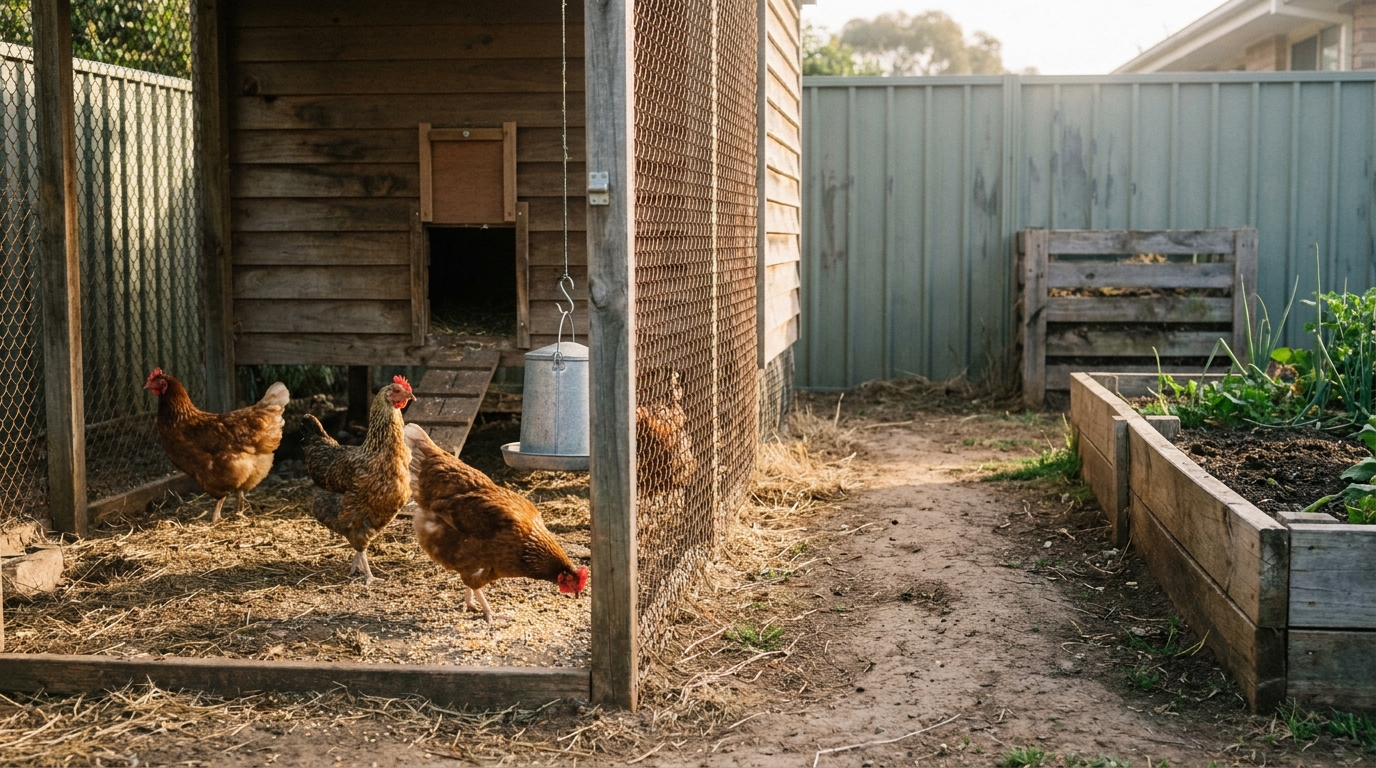
Footprint: a 200–1,500 m² yard. The operation at this scale typically uses 30–80 m² for vegetable production (raised beds or in-ground), 6–15 m² for a chicken coop and run, 5–15 m² for soft fruit and herbs, and a small section for compost and storage.
What to grow and keep: four to six raised beds in seasonal rotation (carrying salad greens, tomatoes, peppers, beans, cucurbits, brassicas in season), 4–8 chickens (egg-laying breeds — Lohmann Brown, Hyline, Australorp, or local mixed breeds; verify supplier credentials and bring birds at point-of-lay rather than as chicks unless you specifically want the chick-rearing experience), 1–3 fruit trees on dwarf rootstock (citrus is the South African default; apple, pear, peach, plum, mulberry depending on climate), soft fruit (strawberries in raised beds, raspberries or granadilla on a fence, paw-paw if your zone supports it), a herb section, a serious compost system, and a worm bin for kitchen scraps.
Real monthly output: R2,000 to R6,000 of supermarket-displacement year-round for a household of four, rising significantly in peak summer when the kitchen garden is at full output and falling in winter when the household leans more on stored produce. Eggs alone, from a flock of six laying birds at peak production, generate roughly 30 eggs a week — at supermarket-equivalent free-range pricing in mid-2026, that is R200–R300 a week of egg-equivalent. Vegetables at this scale, run with the discipline Eliot Coleman documents in The Four-Season Harvest, can yield year-round salad greens for a household of four plus seasonal abundance in summer.
Real time cost: 4 to 10 hours a week sustained. Most of that is morning rounds (chickens, water, harvest, observation, 30 minutes a day), with concentrated labour at planting transitions (2–4 hours, three or four times a year) and a maintenance day per month for compost turning, coop cleaning, and fruit-tree work. The labour curves up in spring (planting), drops in mid-summer (cruising), curves up again in autumn (harvest, preserve), and drops in mid-winter (planning).
Startup cost: R20,000 to R60,000 for a working version. Raised bed timber and soil (R8,000–R20,000), chicken coop and starter flock (R8,000–R20,000), tools, water connections, fruit trees and soft fruit (R3,000–R8,000), compost system, fertiliser, seed stock, fencing where needed. Spread over three to four months rather than all at once; year one is the most expensive and the rest of the budget is rotation costs.
The lesson at this scale: the suburban scale is where the work earns its keep economically and lifestyle-wise both. The hours are real but they are pleasant; the output is meaningful; the household texture changes in ways that are worth more than the rand-equivalent of the supermarket-displacement.
What to skip at this scale: dairy goats (not viable in most suburban zoning), pigs (not viable in most suburban zoning), grain crops (the area requirement is wrong), large livestock (the area requirement is wrong), and aspirational rare-breed birds whose feed conversion is dramatically worse than the laying-hen breeds. Also skip the temptation to scale all four bed-types the first year — start with two beds well, then expand.
Rural plot
The scale at which the productive homestead’s everything-is-possible meets the labour question head-on.
Footprint: 1+ hectares, sometimes much more. The productive operation typically uses 200–800 m² for intensive vegetables, several hectares of pasture for stock, a fruit-and-nut orchard at meaningful scale, one or more outbuildings dedicated to processing, storage, and animal care.
What to grow and keep: everything from the suburban list, plus stock at meaningful scale (sheep, goats, sometimes a single dairy cow, sometimes pigs if the household has the appetite for it), a serious orchard (10–40 fruit trees), the option of grain crops on a small scale (mealies, dryland wheat, oats for cover), and the preservation operation that is the bridge between this work and the year-of-food pantry.
Real monthly output: R6,000 to R20,000 of supermarket-displacement for a household of four, but with a labour cost that genuinely competes with employment. The honest range is wide because the rural-plot output is so dependent on the household’s commitment level. A rural plot that the household engages with for ten hours a week produces less than a suburban garden engaged with for ten hours a week, because the area is bigger and the dispersal of labour is wider. A rural plot that the household engages with for thirty hours a week produces more than the suburban version, but those thirty hours are real and they have an opportunity cost.
Real time cost: 15 to 40 hours a week sustained, depending on the household’s choices about stock, processing, and seasonal labour. The honest accounting is that one full-time household member is roughly the labour input a serious rural homestead requires. If the household has that member, the household’s maths work; if not, the operation either contracts (smaller scope), spreads the labour across more household members, or pays for help.
Startup cost: R80,000 to R300,000+ depending on what the property already has, what stock is brought in, what infrastructure is built. The capital cost is recoverable over five to ten years through supermarket-displacement and product sales; the labour cost is the harder one to capitalise.
The lesson at this scale: productive only makes sense if you (a) value the lifestyle for its own sake, (b) have the labour available without paying for it, or (c) have a paid product that closes the household economics. All three are valid; the household must be honest about which one applies. We have seen rural plots run beautifully on (a) — a household that loves the work and would do it whether or not it produced anything. We have seen them run profitably on (c) — a household whose eggs, honey, or seasonal vegetables sell at the local farmers’ market and close the labour-economics gap. We have not seen them run sustainably on neither (a) nor (c); when the labour is not loved and the products are not sold, year three is the year the operation contracts.
What to skip at this scale: the assumption that because you have land, things will produce themselves. They will not. Land alone does not produce; labour combined with land produces. The honest budgeting question at this scale is the labour question, not the land question.
The cost-benefit calculation
Apply the productive definition to each scale honestly and the picture is clearer than the niche acknowledges.
Townhouse: marginal economic case (R300–R800/month is real but small relative to the household’s grocery bill); strong lifestyle case (taste, freshness, learning, the household-texture argument). Most townhouse households should do this for the lifestyle reasons and not the economic ones. The economics are a bonus.
Suburban: clearly positive economic case at scale (R2,000–R6,000/month against grocery bill of perhaps R8,000–R15,000 for a household of four), plus a strong lifestyle case. Most suburban households should do this if they have the time and the inclination, and the time-cost is the binding constraint, not the money cost.
Rural plot: depends entirely on labour assumptions and product paths. The economic case is positive if the labour is loved or the products are sold. The economic case is negative if the labour is paid-for at market rates and the products are not sold — in which case, the household is paying for the lifestyle, and that is fine, but the maths must be done with eyes open.
The PMBEJD Household Affordability Index gives the most current picture of what the South African household grocery bill actually looks like, and what each scale displaces from it — consult it for current month figures relative to the rand outputs above.
The labour question
The honest disclosure most of this content avoids. Productive homesteading at suburban or rural scale is real work, sustained week after week. Ten hours a week of garden labour is roughly half a day; that is a meaningful claim on household time.
We mention this not as a deterrent but as a realistic input to the decision. Homesteading writing tends to underplay the labour, which is part of what produces the year-two abandonment cycle: the household goes in expecting the labour to be lighter than it is, hits the reality at month four, and tapers off. Going in with realistic expectations about the work protect against this.
A useful labour budget for the suburban scale, in rough hours per week: 30 minutes daily morning rounds (chickens, watering, observation, harvest of immediate-use produce); 2 hours weekly for compost, deeper harvest, planning; 4 hours every fortnight for transitions, maintenance, and project work. That is roughly six hours a week, sustained year-round, with significant variance — peak seasons hit ten hours, dormant winter weeks fall to two or three.
The labour at the rural scale is wider, more seasonally clumped, and more dependent on stock choices. Having an at-home household member transforms what is feasible; not having one constrains the operation tightly. We have seen households contract their rural operation by 60% when a partner returned to off-property work, and the contraction was the right call.
The other honest piece on labour: the work is mostly pleasant. Morning rounds in the cool early hours, hands in soil, the rhythm of livestock, the knowledge that today’s labour produces this afternoon’s salad — these are not unpleasant hours. They are different hours from the household’s normal week, and most households who commit to them find them genuinely restorative. The labour question is real, and the labour is also part of what makes the homesteading life worth choosing.
Common failure modes
The productive homestead fails in remarkably consistent ways, and naming the failures is more useful than romanticising the successes:
- Over-ambitious year one followed by year-two collapse. The classic. Three raised beds become eight; eight chickens become fifteen; fruit-tree purchases proliferate; the household is buried by spring of year two and abandons most of the operation. The fix is start small, prove the discipline, then expand. Two raised beds for a year before adding a third. Six chickens for a year before considering more.
- Wrong crop choices for the climate. A garden full of crops that need more water than the climate provides, or more cold than it provides, or more heat than it provides. The fix is to walk the established gardens of the neighbourhood and grow what is already growing well. The Rand Water Water Wise plant lists are the South African public reference for drought-resilient choice.
- Underestimating water requirements. South African gardens compete with municipal water supply during dry months in many areas. Rainwater capture, drip irrigation, mulching, and water-wise plant choice are the disciplines that turn a thirsty garden into a sustainable one.
- Predator losses on chickens. Genets, mongooses, neighbourhood dogs, raptors. A coop and run that worked in year one stops working in year two when the local genet learns the routine. The fix is over-engineering the perimeter from day one and not waiting for the first loss.
- Soil neglect. A garden whose soil is treated as inert dirt produces less every year. Regular composting, cover cropping, rotation, and the occasional soil test (every two to three years) are the disciplines that make soil more productive over time, not less.
- Tool-buying as a substitute for actually working the land. A new attachment for the tractor; a fancy seeder; specialised pruning equipment. We have lost count of the rural plots that have a shed full of tools and a fallow garden. Tools earn their place by saving real labour on real tasks; tools that are purchased aspirationally usually rust unused.
- Failing to integrate the operation with the household’s actual eating habits. Growing kale that no one eats. Raising rare-breed pork that no one will butcher. Producing more zucchini than the household can give away to neighbours. The fix is grow what the household eats, scaled to what the household actually consumes.
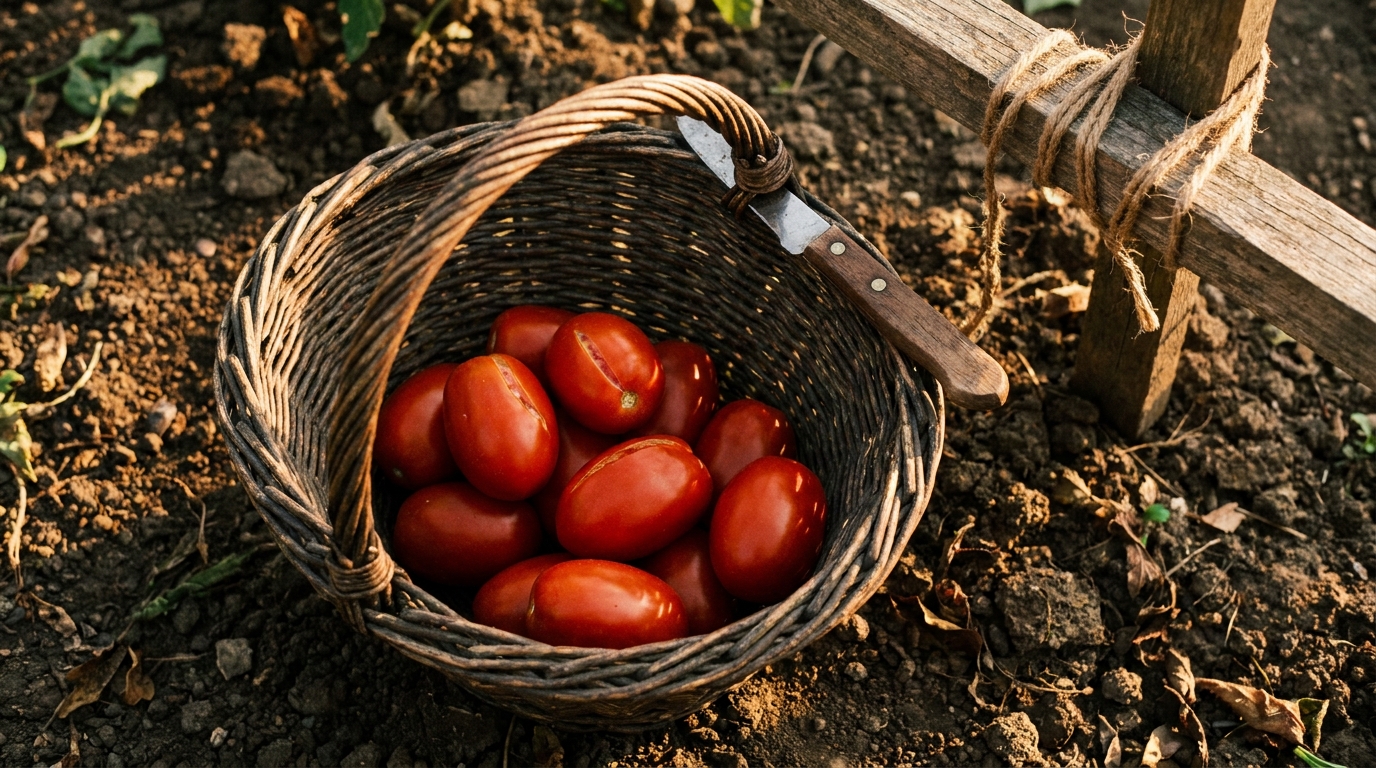
- The chicken-coop romance. A R20,000 designer coop that houses six birds whose eggs cost about R8 a unit on a labour-and-feed accounting. The economic case for chickens lives or dies on the coop cost; a R5,000 functional coop with the same six birds produces eggs at R3 each. Build the functional coop. Skip the romance.
If you recognise yourself in two or more, you are in the same place every operator has been. A productive homestead that has not yet stumbled is one that has not yet been run for long enough. The point is to make them visible.
What to do next
It starts with a single concrete next step, scaled to where you are. Pick yours.
Townhouse readers: pick three herbs your household uses in cooking weekly. Buy one pot, one bag of soil, and three seedlings. Plant them on Saturday. Water them on Wednesday. Harvest them on the next Saturday. That is the entire first move. Everything beyond is iteration on that.
Suburban readers: walk your yard this weekend. Identify the sunniest 10 m² that is not currently doing anything. Plan a four-bed rotation for the next planting season — two beds for salad greens and herbs, one bed for tomatoes and peppers, one bed for legumes and brassicas in rotation. Read The Four-Season Harvest before the next planting season; the method work is much higher-leverage than the equipment work.
Rural readers: do an honest labour audit before adding a new system. How many hours a week does the household actually have for the operation? What does each existing system cost in hours? What does the next system cost? If the maths doesn’t work, contract before you expand. The most productive rural homesteads we know are not the largest; they are the ones whose labour budget matches their footprint.
The companion pieces you will want next: the kitchen garden 12-month plan for the suburban scale, backyard chickens and the honest economics for the chicken-specific question, the 30-day pantry to year-of-food spectrum for the storage side of the operation, and off-grid living: nine honest lessons for the rural-and-off-grid case.
A productive homestead is real food, real labour, and real change to how the household eats and how the household lives. It earns its keep on those three things, in that order. The smallest productive setup at each scale is honest, defensible, and worth doing — at the right scale, for the right household, with eyes open about the tradeoffs.
Take the reckoning sheet with you. If you want a printable version of the math above — three filled-in example reckonings (townhouse, suburban, rural), a blank template for your own scale, the labour-hours discipline page, and the substitution test — we’ve packaged it as a free downloadable PDF. One short email gets it to your inbox.
Sources cited in this piece
- PMBEJD Household Affordability Index — Pietermaritzburg Economic Justice & Dignity, monthly tracking of the South African household food basket.
- Eliot Coleman, The Four-Season Harvest — the standing reference on intensive small-area year-round vegetable production.
- Jean-Martin Fortier, The Market Gardener — the contemporary reference on high-output small-scale market growing.
- Rand Water — Water Wise gardening — South African public-sector authority on drought-resilient gardening.
- FAO smallholder agriculture publications — the international authority on what small-scale agriculture actually produces and what it costs to operate.
Pick your productive homestead scale honestly. Run the numbers. Start small. Earn the next tier.
— SOURCES
-
Pietermaritzburg Economic Justice & Dignity Group — monthly Household Affordability Index tracking the cost of a standard South African household food basket. Reference for grounding food and homestead costs in current rand.
-
The Four-Season Harvest — the standing English-language reference on intensive small-area year-round vegetable production. Method-led, evidence-grounded, applicable beyond the Maine context Coleman writes from.
-
The Market Gardener — the contemporary reference on high-output small-scale market growing. Cited for time-and-output budgeting at the suburban-and-up tier of the homesteading spectrum.
-
Rand Water's Water Wise programme — South African public-sector authority on drought-resilient gardening. Cited for water-budgeting claims in a country where domestic gardens compete materially with municipal water supply.
-
Food and Agriculture Organization of the United Nations — publications on smallholder food production, yields, and labour budgets. The international authority on what small-scale agriculture produces and what it costs to operate.
— FURTHER READING

Starting a Vegetable Garden: A Practical Guide
Starting a vegetable garden the calm, practical way. A South African guide to soil, water, easy crops and steady harvests — evidence over hype.

Productive homestead: where to start, what to skip
A productive homestead is a tradeoff, not a lifestyle — measurable outputs, real labour costs, honest scope. Where to start, what to skip, what we’ll write.